
RPE vs RIR — which should you log?
RPE and RIR are the two most useful subjective metrics in strength training, and they measure the same thing from opposite ends. Here's the practical version — what each is, when each is easier to use, and why it matters for your training log.
RPE = Rate of Perceived Exertion
A 1–10 scale of how hard a set felt. RPE 10 is a true failure set; RPE 7 means you had about 3 reps left in the tank.
RIR = Reps In Reserve
How many more reps you could've done before failure. 0 RIR = failure, 3 RIR = 3 reps left. Inverse of RPE on the same scale.
Pick one and be consistent
Mixing the two within the same log is the fastest way to confuse yourself. Pick the framing that feels natural and stick with it.
Why subjective load matters
Two lifters can squat the same 150kg for 5 reps and one is grinding while the other has 4 more reps in them. Logging only weight × reps misses that gap — and that gap is fatigue, the thing that decides whether next week is progress or a stall.
RPE and RIR are how you log that gap. Same set on paper, very different cost on the body.
When RPE is easier
RPE shines for low-rep, near-maximal work — heavy singles, doubles and triples. "How hard did that feel?" is the more natural question than "how many more could I have done?" when the answer to the second is 0 or 1.
Competitive powerlifters and Olympic lifters lean on RPE for this reason.
When RIR is easier
RIR is more intuitive for hypertrophy work — sets of 8–15 — where you're rarely at true failure and "I had 2 more in me" is a concrete answer that's easier to honest-audit than "that was an 8 out of 10".
Bodybuilders and most general strength trainees default to RIR.
How a tracker uses it
Once you log RPE/RIR per set, patterns appear: same weight creeping in difficulty week after week is fatigue accumulation; same weight getting easier is genuine adaptation; rapid jumps between sessions usually mean sleep or stress.
Frequently asked
Is RPE 8 the same as 2 RIR?
Yes — they're inverses on the same scale. RPE 10 = 0 RIR (true failure); RPE 9 = 1 RIR; RPE 8 = 2 RIR; and so on. Pick whichever feels more intuitive to you and stick with it.
Should beginners use RPE?
Most coaches recommend beginners run linear progression with prescribed reps for the first 3–6 months. RPE/RIR becomes useful once your rate of progress slows and you need to autoregulate fatigue.
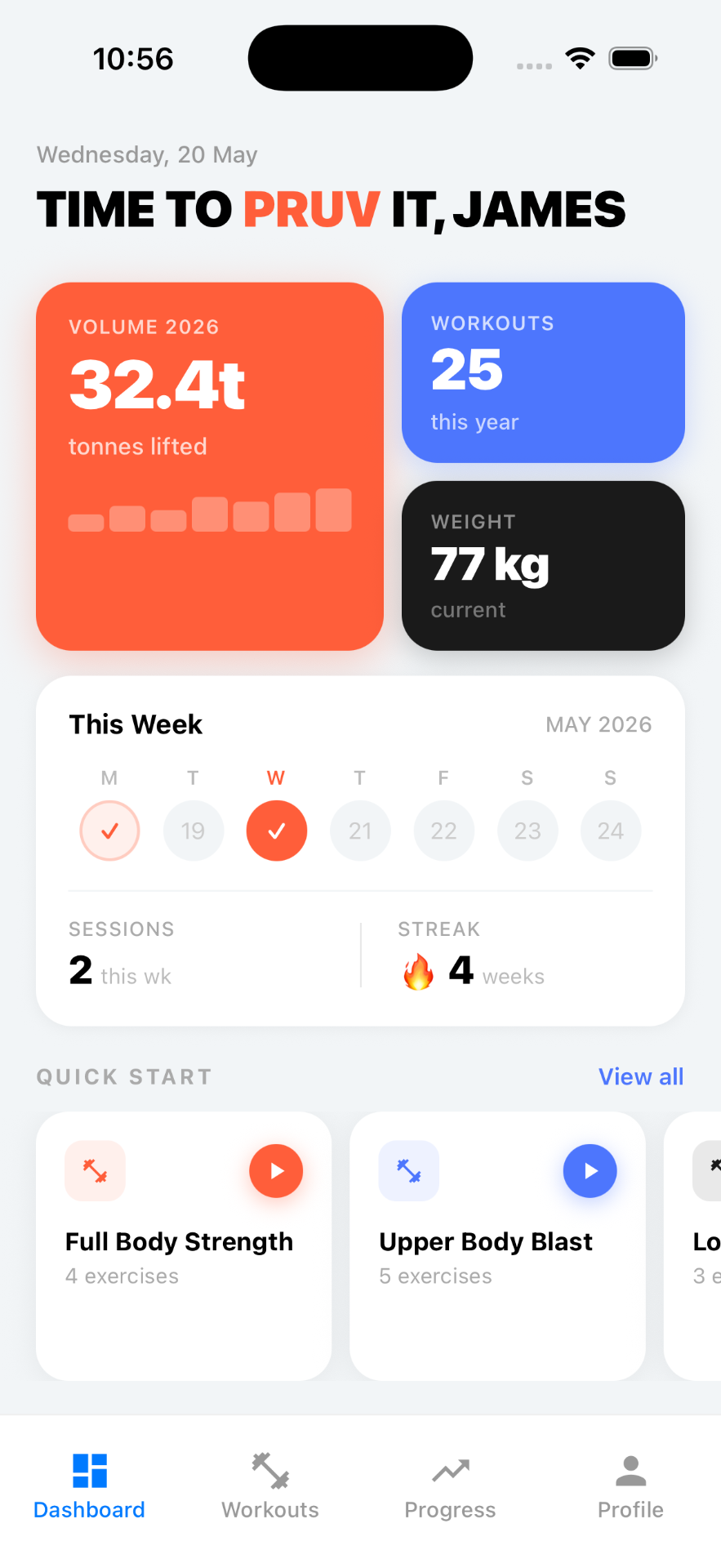
Does PRUV track RPE?
No. PRUV logs weight, reps and set type (warm-up, failure, drop set). If you rate your sets, write the score in a note so it stays with the session.
Log the load.
Read the trend.
Join the waitlist and bring autoregulation into your training log.
By submitting your email you agree to receive launch updates from PRUV. Unsubscribe at any time.
Follow us on Instagram @pruvapp